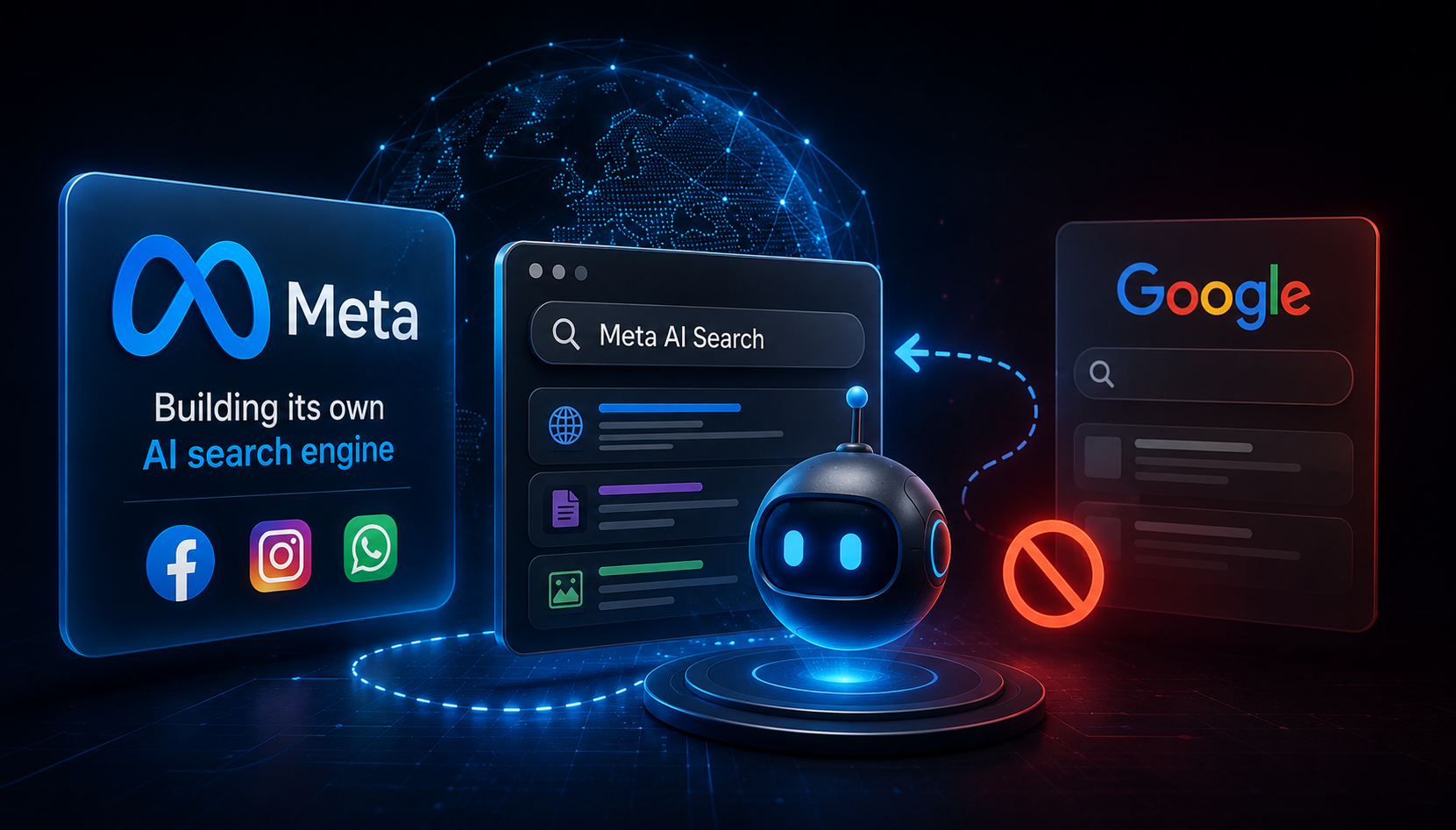
Right now, when Meta AI answers a question about current events, it's quietly leaning on Google and Bing behind the scenes. Reports suggest Meta wants that to stop, and it's already been working on the alternative for well over a year.
What Is Actually Being Reported
According to reporting from The Information, a dedicated team inside Meta, led by senior engineering manager Xueyuan Su, has spent more than eight months building a web index designed to power Meta AI directly, without depending on Google or Microsoft's Bing for answers. The goal is straightforward: give Meta AI its own source of real-time, conversational answers instead of borrowing someone else's.
Meta's crawler, publicly known as Meta-ExternalAgent, has been active on the web since at least mid-2024, officially described by the company as being used "for use cases such as training AI models or improving products by indexing content directly."
Why Would Meta Want Its Own Search Index
The most cited reason is independence. If Meta AI keeps relying on Google or Bing for answers, those companies could, in theory, restrict or end that access at any point, and Meta would have no fallback. Building its own index removes that risk entirely.
There's a second, more strategic reason too. Every search query Meta AI sends to Google currently hands Google a small piece of data about what people are asking. An independent Meta search engine keeps that information, and the value built from it, inside Meta instead.
The Detail That Made This News Again Recently
This story first broke back in October 2024, but it resurfaced with a sharper, more specific edge a few weeks ago. Indie developer Pieter Levels reported his websites were being hit with aggressive crawling from Meta, enough to trigger server load alerts on his own infrastructure. Levels then shared that Meta employees privately messaged him, confirming the company's plan directly: an independent web index, built specifically so Meta's AI search activity never has to touch Google at all.
What This Means If You Run a Website
If this rollout continues, it adds a third major AI crawler your business may eventually need to think about, alongside OpenAI's GPTBot and Perplexity's crawler. This connects to something we've already covered, AI bots are already reading your website, and a Meta-run search index would mean an entirely new audience, billions of Facebook, Instagram, and WhatsApp users interacting with Meta AI, potentially discovering your business through a completely separate system than Google.
Is This Actually Confirmed by Meta
No, and that distinction matters. Meta has never officially confirmed it's building a full competing search engine. What's confirmed is the crawler's existence and its stated purpose around AI training and indexing. The rest, the scale of the ambition, the exact timeline, whether it becomes a true Google competitor, is based on reporting and the Pieter Levels account, not an official Meta announcement. You can read the original reporting on The Information, where this story was first broken.
What This Means for Your Visibility Strategy Going Forward
Even unconfirmed, this points to a pattern worth paying attention to: every major AI company wants its own way of reading the web, rather than depending on a rival's index. For a business owner, that means visibility is no longer a single Google-shaped target. It's slowly becoming several separate systems, each with its own crawler, its own rules, and its own idea of what counts as a trustworthy source.
Not sure how visible your business actually is across the AI tools already reading the web? Get a free visibility audit and we'll show you exactly where you stand.