Google just finished rolling out another search update, and this one is worth paying attention to if your website relies on organic traffic.
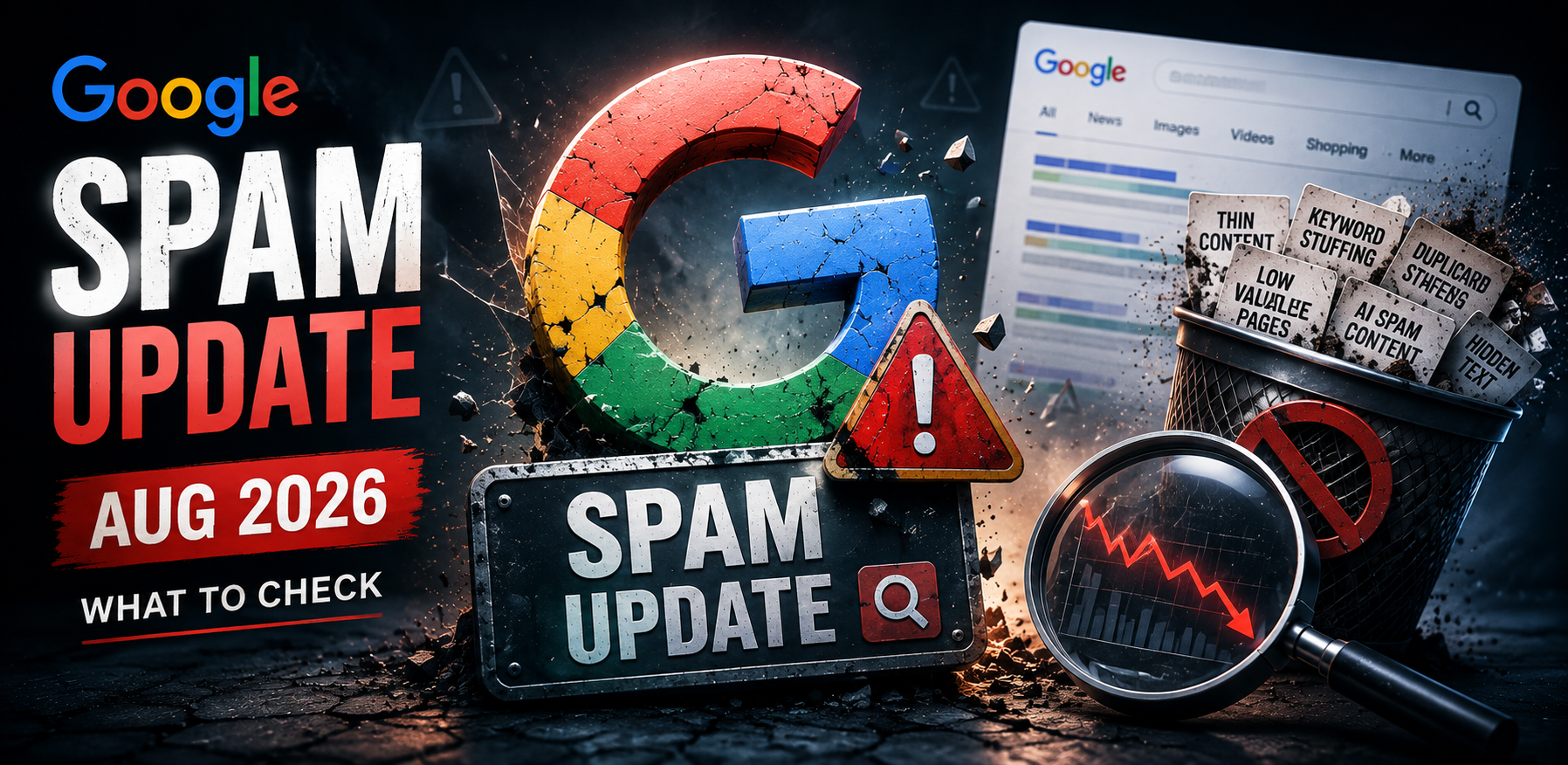
The August 2026 Google Spam Update started on August 18 and finished on August 21. It was a global update affecting all languages. Google has not said that it introduced a new spam policy or identified one specific type of spam that it was targeting.
Still, the update caused noticeable movement across search results, leaving many businesses wondering whether their rankings or traffic were affected.
What Happened With the August 2026 Google Update
Google officially described this as a spam update, not a core update.
Spam updates improve Google's ability to detect and handle practices that violate its search guidelines. Google covers practices such as keyword stuffing, link spam, scaled content abuse, and other forms of search manipulation in its spam policies.
During and after the rollout, SEO tools and website owners reported increased ranking volatility. Some websites lost visibility, while others gained rankings.
So if your traffic changed around August 18, it's worth investigating. But a ranking change does not automatically mean your website was penalised.
The bigger picture is that search itself is changing quickly, which is why questions around whether SEO is still relevant in 2026 are becoming more common.
Did the August Spam Update Affect Your Website?
The easiest way to find out is to look at your own data.
Open Google Search Console and compare your performance before and after August 18.
Clicks: Did organic clicks suddenly decrease?
Impressions: Are your pages appearing less often?
Average position: Did important keywords move?
Top pages: Which pages lost the most visibility?
Search queries: Did you lose visibility for specific topics?
Don't look only at your total traffic. A few important pages may be responsible for most of the change.
What Should You Check After the Update?
Google has not said exactly what the August 2026 Spam Update targeted. So rather than assuming one specific issue caused a ranking drop, review the areas that could create a poor search experience.
Check for repetitive or low-value content
Look for pages that are very similar, provide little original information, or exist mainly to target different versions of the same keyword.
More pages do not automatically mean more visibility. Every important page should have a clear purpose and provide something useful to the reader.
Review your AI-assisted content
Using AI to help create content does not automatically make a page spammy.
The important question is whether the final content is useful, accurate, original, and genuinely helpful.
This becomes even more important as Google AI Mode changes how people discover information, making useful and trustworthy content increasingly important.
If your website has large amounts of content that simply repeats information already available elsewhere, it's a good time to review it.
Look at your backlink profile
If you experienced a major and unexplained ranking change, review the links pointing to your website.
Pay attention to obvious link schemes, manipulative anchor text, and links created mainly to influence rankings.
Check your important pages
Make sure your key pages are still indexed, accessible, internally linked, and working properly.
A ranking drop can sometimes happen alongside a technical issue, so don't assume every change came from the update.
Don't Blame the Update for Every Ranking Drop
This is one of the most important things to remember.
If your rankings dropped around August 18, the timing is worth investigating. But it doesn't prove that the spam update was the only reason.
Competitors can improve their pages. Search behaviour can change. Google can make other adjustments. Rankings can also move naturally.
A ranking drop is a signal to investigate, not a reason to panic.
The role of SEO is changing too, but that doesn't mean SEO is disappearing. The bigger shift is in what it takes to earn visibility as search becomes more complex.
What Should You Do If Your Rankings Dropped?
Compare your Search Console data before and after the update.
Identify the pages that lost visibility instead of assuming the whole site has a problem.
Review the content and check whether it genuinely answers the searcher's needs.
Check internal links to make sure important pages are easy to discover.
Review backlinks for unnatural or manipulative patterns.
Check technical SEO and make sure important pages remain indexed.
Don't change everything at once. Give yourself time to understand what actually changed.
Should You Delete Your AI Content?
Not automatically. AI-assisted content and search spam are not the same thing. What matters is the quality and value of the finished content.
If your content is accurate, useful, original, well edited, and created for people rather than simply to attract search traffic, there is no reason to remove it just because AI was involved.
However, if your website has hundreds of pages offering little unique value, it's worth reviewing that content strategy.
What This Update Really Means for Businesses
The biggest lesson from the August 2026 Spam Update is simple: more content does not automatically mean better SEO.
A strong website needs useful content, clear search intent, good technical foundations, trustworthy information, and a reason for each important page to exist.
If your rankings changed after the update, don't immediately delete pages or rewrite your entire website. Start with the data, identify where the change happened, and then investigate why.
And remember, ranking well is only part of the job. Once someone reaches your website, the page still needs to give them a reason to stay and take action. Traffic without conversions is still a problem.
Not sure whether your website was affected? Get a free audit and we'll help you identify the pages, keywords, and SEO areas that need attention.