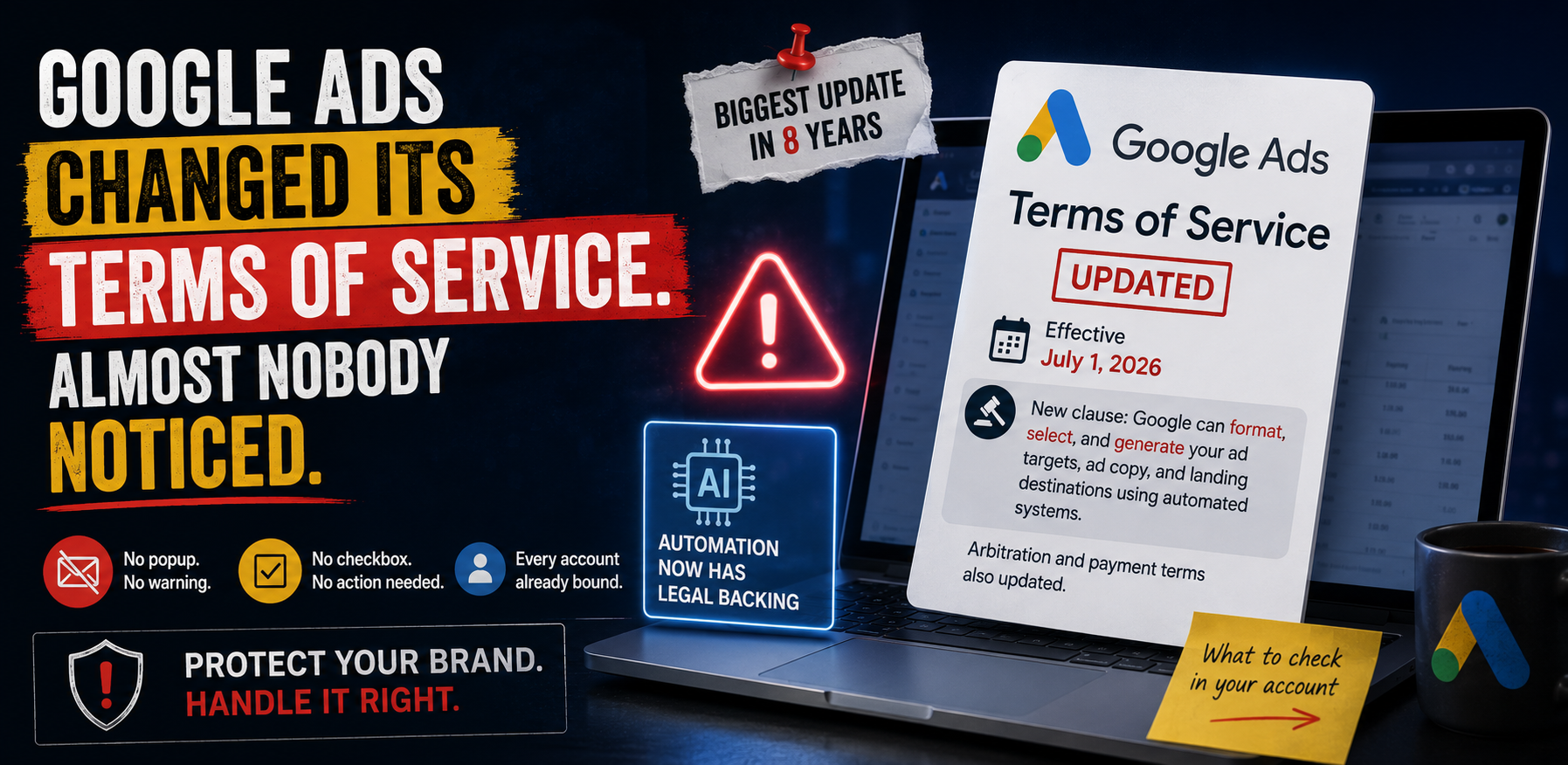
On July 1, 2026, Google rewrote the Google Ads Terms of Service for the first time in roughly eight years. No popup appeared in your dashboard. No checkbox needed ticking. If you have a Google Ads account, you are already bound to the new terms, whether you read them or not.
What Changed in the Google Ads Terms of Service on July 1, 2026
The most significant update is a single clause that gives Google explicit legal authority to format, select, and generate your ad targets, ad copy, and landing destinations using automated systems. This isn't new behaviour, Google's AI has been generating responsive search ad assets and adjusting bids for years. What changed on July 1 is that this now has clear contractual backing instead of sitting quietly inside a settings default.
The updated terms also expand how advertiser-supplied data can be used, including anything typed into conversational tools inside Google Ads, alongside updates to arbitration language and region-specific payment terms.
Did Google Notify Advertisers About the Terms of Service Update?
Google did technically notify advertisers, an email went out to account holders on June 1, 2026, a full month before the terms took effect. But no acceptance, click, or acknowledgment was required for the new terms to apply. If the email got buried, filtered, or simply skipped past, the terms still applied to your account on schedule.
That's not unusual for terms of service updates generally, but the scale of what changed here made this one worth more than a skim.
What Advertisers Are Still Responsible For
It's worth being clear about what this update is not. It's not a transfer of responsibility away from you. According to Google's own Help Center documentation, the advertiser's duty to review, approve, or remove automatically generated assets remains unchanged. Google gained clearer legal footing to automate more of your account by default, it did not take away your ability to review or override what that automation produces.
What to Check in Your Google Ads Account After This Update
- Review your Responsive Search Ads: If certain headlines or descriptions must stay exactly as written, pin them to specific positions to limit AI substitution.
- Check Performance Max and AI Max generated assets: Both let you review and remove anything automatically created that doesn't fit your brand.
- Look at your display and video creative: A separate update starting July 13, 2026 requires disclosure labeling on any ad using AI-generated visuals or video. If you're running creative with AI-generated imagery, confirm it's properly labeled.
- Reread the arbitration section: particularly if you've had disputes with Google Ads support before, the process for resolving them has changed too.
None of this requires panic. It requires about twenty minutes inside your account to confirm nothing automated is running unchecked.
Why This Google Ads Terms of Service Update Matters
This update isn't really Google introducing something new. It's Google formally acknowledging how the platform already works in 2026, automation isn't an optional layer you switch on anymore, it's the environment your account operates in by default. The terms just caught up to that reality.
Google didn't ask permission. It just made what it was already doing official.
That's exactly why active account management still matters. A campaign nobody's checked in on for months is now running inside a system with even broader default authority to make decisions on your behalf, without you necessarily noticing what changed.
This is also a good moment to revisit how your paid advertising is actually being managed day to day, since terms like these tend to matter most for accounts that were already running on autopilot. If you've been keeping an eye on other recent changes too, this update sits alongside the August 17 Smart Bidding change as part of the same broader shift toward automation-first advertising.
Not sure what's actually changed inside your own account since July 1? Get in touch and we'll walk through it with you.