If you run Google Ads on Target CPA or Target ROAS bidding, mark your calendar. On August 17, 2026, Google is changing how its bidding algorithm treats campaigns that are quietly outperforming their set target, and if you don't check your numbers before then, your costs could shift without you touching a single setting.
What Is Actually Changing on August 17, 2026
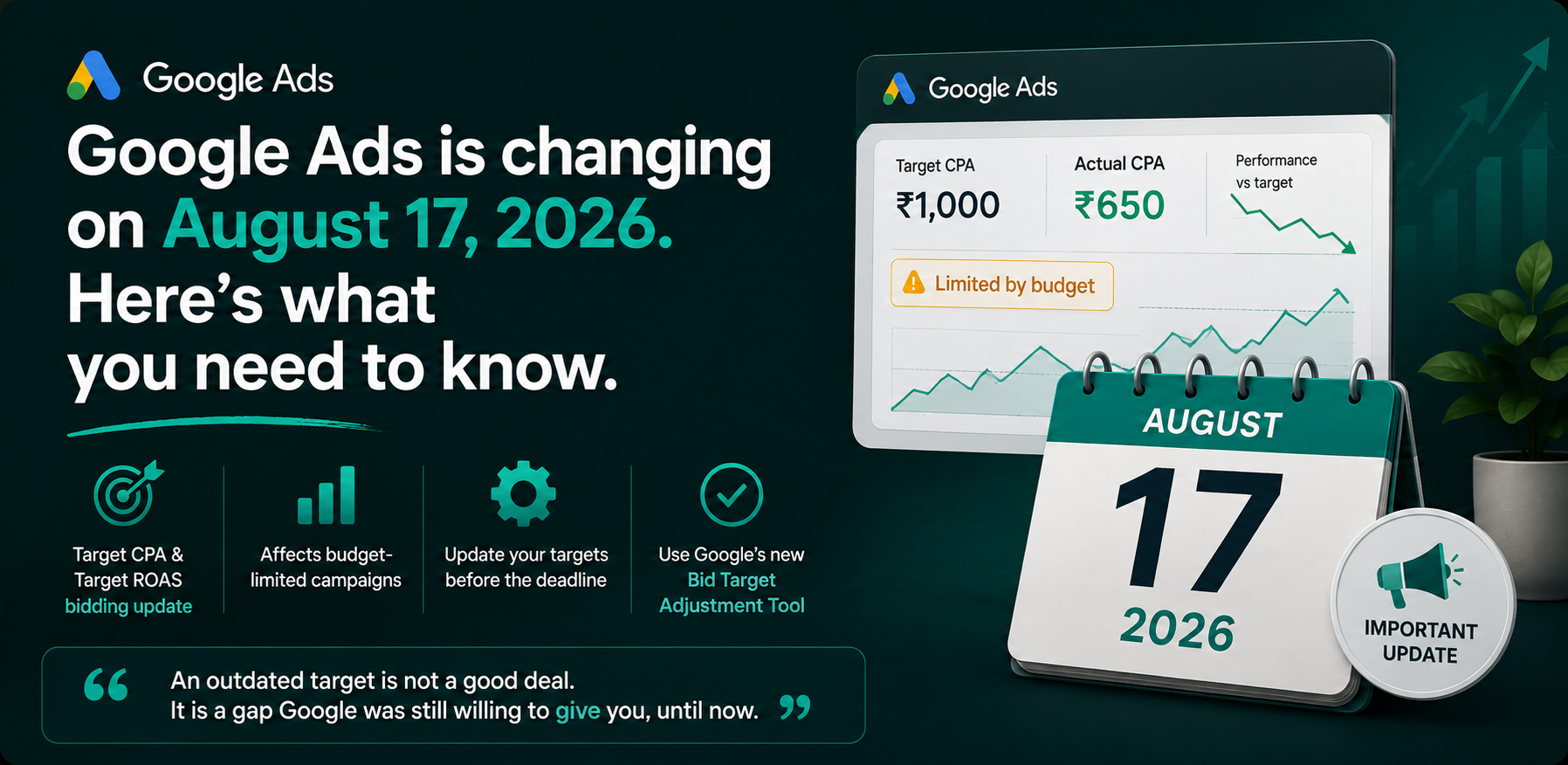
Right now, if a campaign is marked "Limited by budget" and it's beating its Target CPA or Target ROAS, Google is happy to let that gap continue. Say your Target CPA is set at 1,000 rupees, but your actual cost per acquisition has been running closer to 650. Today, Google lets your campaign keep quietly outperforming that number.
From August 17, 2026 onward, that changes. Google's own Ads Help Center confirms the algorithm will start pulling performance closer to whatever target you've actually set, instead of letting your campaign coast on a better number it's been achieving for months.
Why This Only Hits Budget-Limited Campaigns
This update affects Search, Shopping, Performance Max, and Demand Gen campaigns running Target CPA or Target ROAS bidding, but only the ones marked "Limited by budget." If a target has sat untouched for months while performance quietly beat it, this update closes that gap, and closes it in Google's favour, not yours.
Your actual budget doesn't change. Daily and monthly spending caps stay exactly where you set them. What shifts is how the algorithm spends that budget, chasing the number you typed in years ago rather than the number your account is actually capable of hitting today.
What to Actually Do Before August 17, 2026
- Check for the "Limited by budget" label on any Target CPA or Target ROAS campaigns in your account.
- Compare your set target against real recent performance. A big gap here means that campaign is likely to see costs shift after the update.
- Use Google's new Bid Target Adjustment Tool, live now inside Google Ads, to review and update affected campaigns in one place.
- Update your target manually, or switch to Maximize Conversions or Maximize Conversion Value if you'd rather let Google optimise freely within a set budget instead of chasing a fixed number.
Nothing here happens automatically. If you take no action, your account simply performs closer to whatever target is sitting on file, whether or not that number still reflects how your campaign actually runs today.
What This Means for Your Strategy Going Forward
This update is really Google closing a quiet advantage some accounts have been running on without realising it. If your targets were set once, years ago, and never revisited, this is a forced moment to fix that. Campaigns that have been beating stale targets could see real cost increases starting August 17, 2026, not because anything about your business changed, but because the number on file stopped matching reality a long time ago.
An outdated target is not a good deal. It is a gap Google was still willing to give you, until now.
This is also a good reminder that paid advertising works best as an actively managed system, not something set once and left alone. Stale targets like these are exactly what an update like this is built to catch, and exactly why ongoing campaign management matters more than a one-time setup.
Not sure whether your campaigns are affected, or want a second pair of eyes on your targets before August 17, 2026? Talk to us and we'll walk through your account with you.